
Most organisations accumulate security tools the same way they accumulate networking hardware. A firewall when the business first connected to the internet. An endpoint product when someone got a virus. A separate email security gateway when phishing became a problem. A VPN for the remote workers. Maybe a SIEM when compliance demanded it.
The result is a collection of products from different vendors, maintained by different teams or the same stretched team, producing separate alert streams that nobody has the time to correlate, and leaving gaps at every seam where one tool ends and another begins.
The Fortinet Security Fabric is Fortinet’s answer to that problem. Not a product, but an architecture. The question worth asking before you invest in it is whether it genuinely solves the problem or just adds another layer to an already complicated environment.
What the Fortinet Security Fabric Actually Is
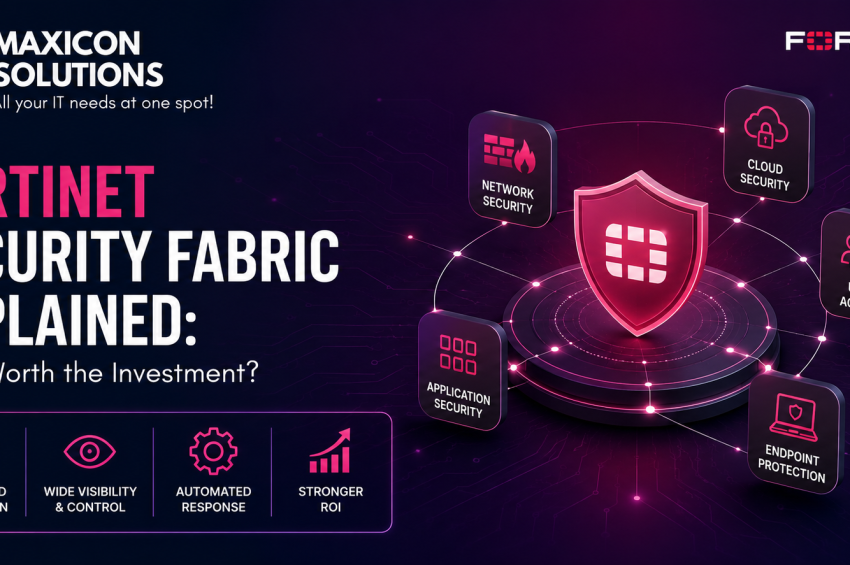
The Fortinet Security Fabric is a next-generation security architecture that integrates various Fortinet products and services into one cohesive security solution. It connects all your security components and enables them to share information and respond to threats in real time, creating a multilayered, adaptive defence system.
In practical terms, that means a FortiGate firewall, FortiAnalyzer log management, FortiEDR endpoint detection, FortiMail email security, FortiNAC network access control, and every other Fortinet component in the environment all share the same threat intelligence feed, the same policy engine, and the same management console. When a threat is detected at one point, every other connected component knows about it immediately and can respond without waiting for a human to correlate the event across separate dashboards.
Fortinet’s Fabric-Ready Technology Alliance Partner Program crossed 3,000 integrations across 400-plus technology partners in July 2025, growing 36 times since its launch in 2015. That number matters because the Security Fabric is not a closed system. CrowdStrike, Armis, and other third-party tools integrate into it, which means organisations that are not running an all-Fortinet stack can still benefit from the unified visibility and orchestration layer.
The key components that most organisations build around are FortiGate firewalls at the network perimeter and segmentation points, FortiAnalyzer for centralised log management and analytics, FortiManager for policy management across all FortiGate deployments, FortiGuard Labs for real-time threat intelligence, and FortiClient for endpoint visibility and zero-trust network access. Everything else- FortiSIEM, FortiSOAR, FortiNAC, FortiWeb, FortiMail, builds on top of that foundation.
What Changed in 2026
The Fortinet Security Fabric has been evolving for several years, but 2026 brought two significant additions that change what it can do operationally.
FortiSOC: Announced in June 2026, FortiSOC is a unified cloud-delivered security operations platform that brings together six security operations functions into a single SaaS experience, embedding agentic AI to autonomously investigate and correlate alerts across assets and identities, then recommend or execute response actions under analyst oversight. Before FortiSOC, running a full SOC on the Fortinet platform required deploying FortiAnalyzer, FortiSIEM, FortiSOAR, and FortiTIP as separate products. FortiSOC consolidates all of those into one subscription with one console. Native integrations across the entire Fortinet Security Fabric and thousands of third-party connectors eliminate coverage gaps and help organisations automate detection and response across security, IT, and business systems.
FortiAI across the Fabric: FortiAI represents AI capabilities natively embedded throughout the Fortinet Security Fabric, enabling businesses to govern, protect, and operate AI at any scale, with shared intelligence, shared context, shared reasoning, and shared enforcement across network, users, endpoints, and agents. This is not AI as a separate licensed module. It runs across every component in the Fabric simultaneously, which means threat detection at the firewall, endpoint investigation, and SOC triage all benefit from the same AI layer without requiring separate configuration or separate licensing.
For organisations in Pakistan that do not have a dedicated security operations team, these two additions are particularly meaningful. FortiSOC’s agentic AI reduces the analyst burden significantly. Threats are investigated automatically, playbooks execute without requiring manual triggers, and recommendations surface in plain language rather than requiring a specialist to interpret raw log data.
The Fabric in Practice: What It Changes Day to Day
The most tangible operational difference a Security Fabric deployment makes is in the time between detecting a threat and containing it.
In a fragmented multi-vendor environment, a threat detected at the firewall produces an alert in one console. Whether that threat has also touched an endpoint requires manually checking a separate console. Whether the user account involved has anomalous activity requires checking a third. Correlating those three data points to understand the scope of the incident is a manual process that takes time and expertise.
In a Security Fabric environment, the integration allows each device to instantly communicate with others when a threat is detected, enabling automated response and faster mitigation of risks. The firewall alert, the endpoint telemetry, and the user identity context are correlated automatically. A compromised endpoint can be quarantined before the analyst has finished reading the initial alert. A user account showing lateral movement can have its access revoked across all connected systems in seconds rather than minutes.
FortiAnalyzer ingests, normalises, and enriches data across security and network environments as the unified data lake of the Fortinet Security Fabric. Analysts gain structured dashboards covering IoT, SOC, email metrics, and endpoint vulnerability, offering actionable insights into risks and trends from a single source of truth.
The management side sees a similar consolidation. FortiManager controls policy across every FortiGate deployment in the environment from a single console. A rule change made once propagates to every site simultaneously. An audit of the security posture across every location runs from a single interface rather than requiring separate logins to each device.
The ROI Question
The honest answer is that the Fortinet Security Fabric is a significant investment if you are starting from scratch. The question is whether the alternative, continuing to add point solutions that do not share context and require separate management, is actually cheaper over a meaningful time horizon.
A third-party assessment of the Fortinet Security Fabric found it delivers, on average, 11.5% in cost and productivity savings compared to managing separate best-of-breed point solutions.
The Secure SD-WAN component, which is part of the Fabric for organisations with multiple sites, has been assessed independently. Forrester’s Total Economic Impact study of Fortinet Secure SD-WAN found that end customers could see an average 300% ROI with only eight months payback, with team productivity potentially increasing by 50% and a 65% reduction in network disruptions.
Organisations consolidating onto the Security Fabric have seen costs reduce by over 65% by eliminating multiple standalone solutions. The cost savings come from three places: fewer separate licensing contracts, reduced management overhead from operating a single platform, and faster incident response that reduces the time and cost of each security event.
The tools consolidation argument is not hypothetical. An organisation running a separate firewall vendor, a separate endpoint product, a separate SIEM, and a separate network access control solution has four separate licensing renewals, four separate support contracts, four separate training requirements, and four separate integration maintenance burdens. Consolidating onto the Security Fabric does not mean buying everything from Fortinet immediately, but it does mean that each Fortinet product added to the environment reduces integration complexity rather than adding to it.
Where the Fabric Makes Sense and Where It Does Not
The Fortinet Security Fabric delivers the most value when a meaningful portion of the security infrastructure is already on Fortinet products. The shared context, automated response, and unified management all depend on components sharing the same platform. A single FortiGate firewall is a good firewall. A FortiGate firewall connected to FortiAnalyzer, FortiEDR, and FortiNAC is a security ecosystem with fundamentally different detection and response capabilities.
For organisations that are heavily committed to other vendors, particularly those with large Palo Alto or Cisco infrastructure investments, the switching cost needs to be weighed against the integration benefits. The Fabric-Ready programme mitigates this to a degree. CrowdStrike and Armis integrations mean you do not have to displace every existing tool to benefit from the Fabric’s orchestration layer.
For businesses in Pakistan that are making their first serious investment in enterprise-grade security infrastructure, or that are refreshing aged equipment and have the opportunity to choose a direction, the Security Fabric approach has a compelling case. Building around a unified platform from the start avoids the integration debt that accumulates when tools are added piecemeal. The management overhead stays manageable even as the environment grows.
The businesses where the investment is most clearly justified are those running multiple sites, managing distributed teams, operating in regulated industries with compliance reporting requirements, or handling enough security events that the automation and correlation capabilities materially reduce analyst workload. That describes most mid-to-large enterprises in Pakistan’s financial services, telecom, manufacturing, and government sectors.
How Trubyte Deploys the Fortinet Security Fabric in Pakistan
Maxicon is an authorised Fortinet partner in Pakistan, deploying and managing Fortinet Security Fabric environments for businesses in Karachi, Lahore, and Islamabad.
As a Fortinet partner in Karachi, we work with financial institutions, corporate headquarters, and large commercial operations whose security architecture spans multiple locations and needs consistent policy enforcement across all of them. As a Fortinet partner in Lahore, we support manufacturing and technology businesses that are consolidating fragmented security tooling onto a unified platform. As a Fortinet partner in Islamabad, we work with compliance-sensitive organisations that need the audit trail, log management, and centralised reporting that FortiAnalyzer and FortiSOC provide.
The deployment does not have to start with the full stack. Most organisations begin with FortiGate firewalls and Forti Manager, then add FortiAnalyzer for visibility, then extend into endpoint and SOC capabilities as the environment matures. Each addition integrates into what is already in place rather than requiring a separate implementation project.
If you are evaluating whether the Fortinet Security Fabric is the right direction for your environment, contact Trubyte to talk through where your current architecture has gaps and what a phased consolidation onto the Fabric looks like.
Frequently Asked Questions
What is the Fortinet Security Fabric? The Fortinet Security Fabric is a unified security architecture that connects Fortinet’s products, including firewalls, endpoint security, email security, SIEM, and network access control, into a single platform where all components share threat intelligence, policy context, and management. It also integrates with over 3,000 third-party tools through the Fabric-Ready Technology Alliance Partner Programme.
Does the Fortinet Security Fabric require an all-Fortinet environment? No. The Fabric-Ready programme includes integrations with more than 400 technology partners covering endpoints, cloud platforms, and network tools. Organisations can extend Security Fabric orchestration and visibility to non-Fortinet tools, though the tightest integration and automated response capabilities work best when core components are on Fortinet products.
What is FortiSOC and how does it fit into the Security Fabric? FortiSOC, launched in June 2026, is a unified cloud-delivered SOC platform that consolidates FortiAnalyzer, FortiSIEM, FortiSOAR, and FortiTIP into a single subscription and console. It uses agentic AI to automatically investigate and correlate alerts, then recommend or execute responses under analyst oversight. It is part of the Fortinet Security Fabric and replaces the need to deploy those four products separately.
What ROI should organisations expect from the Fortinet Security Fabric? A third-party assessment found the Fortinet Security Fabric delivers an average of 11.5% in cost and productivity savings compared to managing separate best-of-breed solutions. Forrester’s Total Economic Impact study of Fortinet Secure SD-WAN found a 300% ROI over three years with payback in eight months. Organisations consolidating onto the Fabric have reported cost reductions of over 65% by eliminating multiple standalone solutions.
How can Pakistani businesses get started with the Fortinet Security Fabric? The most practical starting point is a FortiGate firewall deployment with FortiManager for centralised management and FortiAnalyzer for visibility. Trubyte is an authorised Fortinet partner in Pakistan, handling deployment, configuration, and ongoing managed support across Karachi, Lahore, and Islamabad. Contact Trubyte to discuss where your current environment has gaps and what a phased Fortinet Security Fabric deployment looks like.

Fortinet Partner in Pakistan: How to Choose the...
September 2, 2026
Veeam Restore Validation for a Business Recovery Exercise
September 2, 2026